
Friday, January 29, 2021

Power of the Retail Investor


Power of the Retail Investor

In recent weeks, and more notably recent days, shares of GameStop [GME] and AMC Entertainment Holdings [AMC] have been gobbled up hordes of retail investors. So much so that prices have gone up 320%, and 161% just since Monday, respectively. In “GameStop Mania Reveals Power Shift on Wall Street—and the Pros Are Reeling”, a recent article published in the Wall Street Journal, journalists Gunjan Banerji, Juliet Chung, and Caitlin McCabe explain how this has been happening and the culprit behind these mammoth price movements.
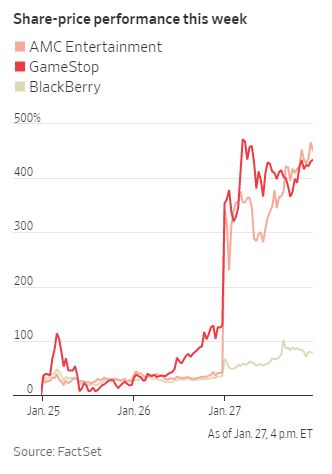

What started as a general conversation about the potential value of GameStop on popular platforms like Reddit, Facebook, Twitter and Discord has turned into an all-out war “between professionals losing billions and the individual investors jeering at them on social media.” So much so that regulators within the SEC are beginning to look into the potential of market manipulation.

Monday, January 25, 2021

Market Predictions


Market Predictions

“The only function of economic forecasting is to make astrology look respectable.”  – John Kenneth Galbraith, Economist


THE 2021 MARKET PREDICTIONS ARE IN, AND THEY’RE PROBABLY WRONG.


Every year, the top investment banks, research institutions, and market analysts make their predictions on where the S&P 500 (stock market) will close the year. They have mountains of research at their disposal, a slew of economic indicators, and they still get it wrong most of the time.

Take 2008 when the markets fell 38% as an example:

  • “Stocks will reach new record highs at some point during the upcoming year.” – Robert C. Doll, Vice Chairman and Chief Investment Officer of Global Equities at BlackRock (January 2009)
  • “It is hard for us, without being flippant, to even see a scenario within any kind of realm of reason that would see us losing one dollar in any of these [credit default swap] transactions.” – Joseph Cassano, AIG financial products head (August 2007)
  • “The Federal Reserve and Congress have delivered a ton of economic stimulus, and that stimulus is set to juice up an economy that has been weak, but not terrible. If everything goes according to plan, the economy will grow faster in the second half of the year, and a recession will have been avoided.” – Kevin Hassett, American Enterprise Institute (June 2008)

Saturday, November 14, 2020

What is "The Market"?


What is “The Market”?

Volatility has played a big part in 2020 and there’s no sense it will stop anytime soon. More people are paying attention to the ebbs and flows of the stock market – whether they want to or not – thanks in large part to the news cycle. “Dow Soars 800 points…”, “Nasdaq jumps 2%…”, “S&P Futures eases below 3,600…”

There are countless attention-grabbing headlines all seemingly referring to the same stock market, but promoting different letters and indices with varying percentages and numbers. What is the difference between the Dow Jones, the Nasdaq, and the S&P 500? And what does “The Market” actually mean?

The Dow Jones Industrial Average

One of the most widely known, and America’s original stock index, the Dow Jones is made up of 30 of the largest stocks from each major sector, excluding utilities and transportation. The value of the index is price-weighted, which means the index is only affected by changes in stock prices. A 1% price change for UnitedHealth Group ($351.70/share) has a much larger impact on the index than a 1% change in Cisco Systems (39.33/share).

Is the Dow a good measure of the stock market? 

Monday, April 16, 2018

Economically Speaking - Part 1

There has been a lot going on lately and for the benefit of my and hopefully you, I'm going to get my thoughts down. It's like bumper cars in my brain right now and I hope to get this sh..tuff more organized. Almost daily, something new will come to the foreground command my attention. I wake and wonder what I will unintentionally focus on today. Will it be: trade wars, war wars, unemployment, interest rates, inflation, the yield curve, quantitative easing, GDP growth, cryptocurrency being wacky....you get the picture.

In no particular order, here are my own opinions on the things we have been hearing. As always, from an Uninformed Investors point of view.

I've decided to make this a multi part post. It would be too long to put it all here and I did not use my time wisely and the things I wrote about earnings pertain to events today [4/16] that should be posted today. So, Part 1!


Yield Curve

The spread between the short term and the long term yields are thinning. At this point it isn't any cause for concern, more so just something I'm keeping in the back of my mind. Why is this important? Every recession has been preceded by a negative spread between the 10 year treasury and 2 year treasury yields. The average time is about 18 months, or a year an a half.

Saturday, March 24, 2018

'Reminiscences of a Stock Operator' Is A Welcomed Change

Reminiscences of a Stock Operator
Written by: Edwin Lefevre
Foreword by: Tim Price


This was an all around phenomenal book to read. Recently I have been focusing on reading non-fiction and that can get so, so boring. I actually started listening to Hamilton on tape for my drive to and from work and, though very interesting, very boring. Between the hum-drum ebb and flow of my 9-5, this was a welcomed change.

Reminiscences of a Stock Operator is a fictional representation of the life of Jesse Lauriston Livermore, a stock trader in the early 1900's. Using the pseudonym Jesse Livingston, author Lefevre dives into the experiences had by Livermore himself. It begins in a bucket shop in New England and ends up on Wall Street. What really pulls readers in (me) are the gains and losses. Growing the few dollars he started with into over $10 thousand, losing it all. Making a few million, then soon finding himself in massive debt. Figuring out what he'd done wrong and making that million back - and more.

That part is true.

Monday, March 12, 2018

The February Budget

Having a budget is one of the most important aspects of personal finance. Whether a natural born spender, saver, or anywhere in between, knowing where your money is going is of almighty importance.

I took the time to catalog and write down everything I spent money on in the month of February. I would consider myself a natural born saver, so some may find this boring. I bring a lunch to work from home essentially every day. Dinner is home cooked almost every day. I also 23 and don't have to pay for health insurance yet. Shout out ma and pa.

My girlfriend has been reading what are called, "Money Diaries" from Refinery 29 and I am amazed at the lack of saving or general knowledge of basic personal finance. I understand being young and being free and traveling and doing what you want, but at some point ya gotta think about your future. If you are turning 30 and have saved nothing, or put nothing towards retirement, you are far behind.

Math Example!